
Exhibitions
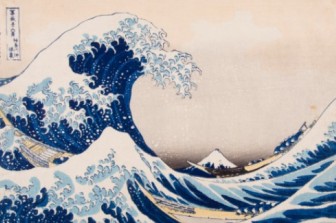
Treasures of the Tikotin Museum of Japanese Art
On the celebrated occasion of the 60th anniversary of the Tikotin Museum of Japanese Art, a wide variety of artworks from the Museum’s collection will be displayed. It is one of the most important and fascinating collections outside Japan. The collection comprises mostly of Japanese artworks from the Felix Tikotin Collection, to which donations of private collections were added, among them, the collections of Lewis B. Gutman and Daniel and Hilda Lebow of New York, the collection of Abraham Horodisch of Amsterdam, the collections of Shulamith and David Rubinfien and Sandra and Kenneth Bleifer of California, the collection of Michael Rukin of Boston and many others.
Tuesday, 28.09.21
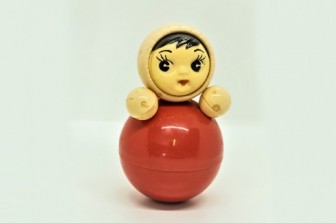
Perestroika in Haifa 30 Years of Aliyah from the Former Soviet Union
Current Exhibition
This exhibition marks three decades since that major wave of immigration from the former Soviet Union. The influx made a decisive impact on Israel, not only in terms of its sheer numbers, but in the distinct culture and outlook that the new immigrants brought with them. Although they settled throughout the country, the city of Haifa stood out because of the size of the community that made its home there. Its presence began to be felt throughout the city, on Russian-language signs, in shops, a variety of workplaces, and more. The new immigrants were able to preserve their old culture and traditions almost entirely, while at the same time acclimating to their new country. They rebuilt their lives in Israel – and within it, Haifa – achieving in essence their own private perestroika.
Saturday, 22.10.22
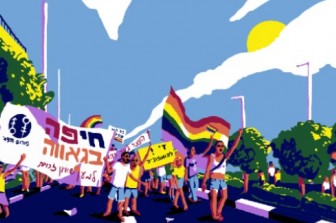
"What Will The Neighbours Say?"
Queer Life in Haifa 2007-1932
The history of Haifa's gay community is long and fascinating, yet despite its importance on both the local and national level, it has largely remained concealed. In the study of queer history in Israel, as a field addressing the plight of sexual and gender minorities, it is the history of Tel Aviv that has most often been documented; Tel Aviv also figures prominently in the collective memory of the local gay community. The chronology of the gay struggle in Israel, including films on this subject, tends to tell a Tel-Avivian tale, with occasional flickers of Jerusalem.
Saturday, 02.04.22
Exhibition curators: Dotan Brom, Yoav Zaritsky, and Adi Sadaka (the Haifa Queer History Project) and Inbar Dror Lax
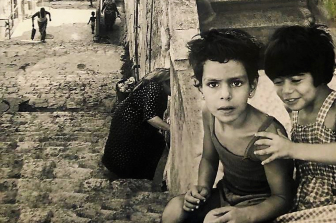
"A Black Flag in a Red City"
Wadi Salib: 1948-2019
The exhibition A Black Flag in a Red City illuminates a chapter in the history of Haifa's Wadi Salib neighborhood, the social implications of which are absent from most of the urban and national "spaces of memory." The exhibition focuses on the voices of the residents of Wadi Salib in the second half of the twentieth century, reflecting a personal and collective memory of urban history written "from below." Using exclusively visual means, the exhibition presents experiences of marginality, injustice, and exclusion, alongside the development of a diverse and lively social fabric. This reality fostered processes of social organization and resistance, climaxing in the protests of July 1959.
Sunday, 11.10.20
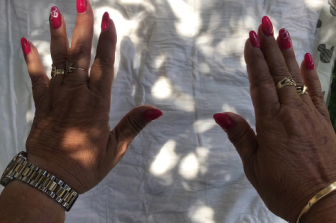
Space for Community Art: Maja Gratzfeld: Manual Labor
Maja Gratzfeld came from Germany to Israel as part of a student exchange program with the Bezalel Academy of Arts and Design. In Jerusalem she met her partner, and together they decided to start a family in Haifa. During the COVID-19 period, Gratzfeld found herself with a newborn baby, in a new country, struggling to get by in a foreign language. With movement restricted to a 500-meter radius of her home under the lockdown regulations, in a nearby park she met a few elderly women, nannies aged fifty to seventy who make their livings taking care of other people's children, and they became her community. It was no coincidence that Gratzfeld met them in a public park in Haifa's Carmel area, whose population is typically of a high socio-economic ranking that can afford such service.
Curator: Yifat Ashkenazi
Saturday, 28.10.23
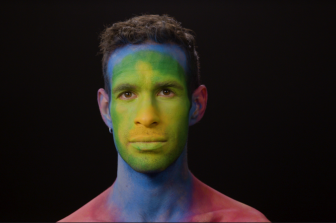
Space for Community Art: Or Peter: Persona, Between Screen and Mask
The exhibition presents some of the personas assumed by Peter. They are offered for viewers to choose, as masks that will either hide them or set them free. We do not have to choose one mask only. We may change masks and metamorphose whenever we want, whether through a physical or a virtual mask.
Wednesday, 18.10.23
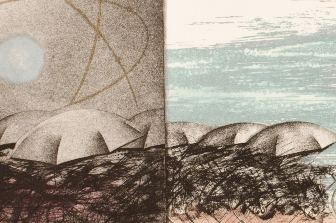
"New Acquisition V"
This is the fifth exhibition of its kind at the Tikotin Museum since re-opening to the public in 1995. Once again, we are proud to present a broad spectrum of artworks donated to or acquired by the Museum during the years that have elapsed since “New Acquisitions VI” in 2014. Traditional and modern prints, clothing accessories and other items are included in this exhibition.
The Museum’s collection has been augmented in various ways over the years. We acquire modern and traditional Japanese works of art, mainly in genres that enrich and sustain the collection, and artworks from new fields as well. Artists exhibiting either solo or in group exhibitions donate their own works to the Museum. Furthermore, some Japanese artists who have yet to be exhibited at the Museum also donate works. The collection has also grown thanks to collectors’ gifts and donations.
Saturday, 22.08.20
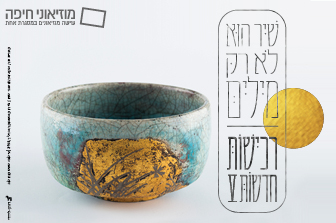
"Poems Are More than Words"
In early ink drawings it was customary to include gasen (writing). Gasen is original prose or verse, or a quotation from classical literature or poetry. In some instances, the text is added by a friend or admirer of the artist, and in others by the artist himself. Beneath the text the signature and seal of the poet are added. During the Edo era (1603-1868), the long tradition of poem-paintings
also began to appear as ukiyo-e (pictures from the floating world),
the woodblock print genre. Although ukiyo-e is considered a
popular art form, it is still closely linked to the classical Japanese
culture. This is evident in the integration of classic tanka poems
in the paintings or prints. An innovation of the Edo period was
illustrating poetry anthologies. The best known of these is "One
Hundred Poems of One Hundred Poets" (Hyakunin isshu).
Saturday, 22.08.20
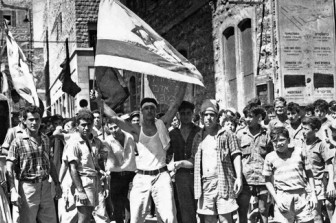
Oskar Tauber: photo-journalist
From "A Black Flag in a Red City"
In the 1950s, a number of professional photographers were active in Haifa. Some worked for local institutions and government bodies. Amiram Erev (the “Solel Boneh Photography Studio”) and Moshe Gross (the “Keren Or” studio), for example, documented the period’s bustling industries and massive surge of construction. Alongside Arav and Gross, photographers passing through the city — such as Boris Carmi and Zoltan Kruger — commemorated its unique views.
Saturday, 02.05.20
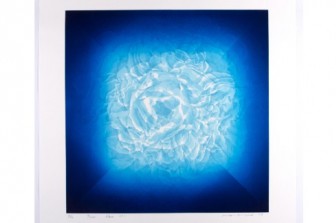
60 Contemporary Japanese Prints
The exhibition "60 Contemporary Japanese Prints", celebrating the sixtieth anniversary of the Tikotin Museum of Japanese Art, is the outcome of a joint initiative between the Yoseido Gallery, Tokyo, and the Tikotin Museum. On this festive occasion we are delighted to exhibit works by sixty of the finest contemporary Japanese print artists. Fifty-seven artists decided to donate their works to the Museum collection at the close of the exhibition and the Yoseido Gallery donated the remaining three works to the Museum.
Tuesday, 28.09.21
Please contact us and we will contact you as soon as possible